Phuket Old Town Complete Guide: Shophouses, Museums, Street Art, Food Prices and the Sunday Market in 2026/27
Last verified: 19 November 2026. Prices in this guide were checked on 19 November 2026 against the named sources at the end: Phuket 101's Old Town, museum and restaurant pages (updated September–October 2026), the Tourism Authority of Thailand (TAT) and Phuket City Municipality listings for the Lard Yai Sunday Walking Street, museum listings checked in October–November 2026, the Michelin Guide listing for Roti Taew Nam, and 2026 Phuket transport guides compiling songthaew, Smart Bus, Grab, Bolt and taxi fares. Prices are in Thai baht (฿). Where a figure is a typical range rather than a fixed tariff, the text says so. One warning before any table: Old Town prices and Old Town opening days are two different kinds of fact. Prices are stable and printed in this guide. Weekly closing days are not — the listings for the Thai Hua Museum disagree with each other about whether it closes on a Monday or a Wednesday, and several Old Town businesses close on a Monday. Check the day before you go if a museum is the whole point of your trip.
Every Phuket guide sends you to the beach. This one sends you fifteen kilometres inland, to the island's actual capital, because Phuket Old Town is the most rewarding half-day in Phuket — and the cheapest. There is no entry fee for the quarter itself, the best museum in it is free, breakfast costs less than a beach lounger, and the whole historic core is about a square kilometre of streets you can walk end to end in fifteen minutes. What it costs you is planning: which day you go matters more here than anywhere else on the island, because Sunday gives you the island's best night market and Monday gives you a row of closed shutters.
If you only read one table, read the day-of-the-week table. If you only follow one rule, follow this one: go on a Sunday if you can, go early in the morning if you can't, and never make Monday your Old Town day.

Phuket Old Town at a glance
| Question | Answer |
|---|---|
| Where is it? | The historic quarter of Phuket Town (Phuket City), southeast Phuket, around Thalang, Dibuk, Phang Nga, Krabi and Yaowarat roads and Soi Romanee |
| How far from Patong? | About 15 km, 30–45 minutes by road depending on traffic |
| How long do you need? | 1 hour for a photo walk, 3–4 hours for the full loop with a museum and lunch, a full day on a Sunday |
| What does the quarter itself cost? | Nothing. Walking the streets, the shrines and Museum Phuket are all free |
| What do the paid sights cost? | Thai Hua Museum ฿200, Chinpracha House ฿150 — ฿350 total for both |
| Best day | Sunday: streets in the afternoon, Lard Yai market 16:00–22:00 |
| Worst day | Monday: Museum Phuket closed, several restaurants and shops closed |
| Best time of day | Before 09:00 for empty streets and dim sum; 16:30 onwards on a Sunday |
| What is it famous for? | Sino-Portuguese shophouses, Chinese shrines, street art, Peranakan (Baba) food, the Sunday Walking Street |
| Is there a beach? | No. That is the point. Come here on the day you are beached out, rained out, or flying out late |
Phuket was a tin island before it was a tourist island. From the mid-1800s, Hokkien Chinese miners and merchants, many arriving via Penang, built shophouses in Straits style: shop below, family above, European stucco and shutters outside, Chinese courtyards inside, and a covered five-foot way in front that keeps you dry in rain and shaded in sun. Their Peranakan (Baba-Nyonya) culture gave Phuket its kebaya dress, its shrines and its food — recognised in 2015 when UNESCO named Phuket a Creative City of Gastronomy. The F.A.T. street-art project followed in 2016.
The streets worth walking, street by street
The Old Town is small enough that you navigate by street name, not by map. These are the streets you will actually use, in the order most people walk them.
| Street | What is on it | Best time | Cost |
|---|---|---|---|
| Thalang Road | The spine: the longest unbroken row of restored shophouses, fabric and herb shops, kopitiams, cafés, the Sunday market | Before 09:00, or Sunday from 16:00 | Free to walk |
| Soi Romanee | The famous short lane off Thalang: pastel facades, cafés, ice cream, guesthouses | Before 09:00 for an empty-lane photo; dusk for the lights | Free to walk |
| Dibuk Road | Parallel to Thalang, quieter and grander: big mansions, Wat Mongkol Nimit, Lock Tien food court at the Yaowarat corner | Morning | Free to walk |
| Krabi Road | The museum street: Thai Hua Museum at no. 28, Chinpracha House at no. 98, Blue Elephant mansion restaurant | 09:00–16:30, museum hours | Museums ฿150–200 |
| Phang Nga Road | Shrine of the Serene Light down a side passage, Museum Phuket and the yellow clock tower, On On Hotel, amulet market | Any daylight hour | Shrine and Museum Phuket free |
| Yaowarat Road | The cross street: more shophouses, local restaurants, the Lock Tien corner | Lunch hour | Free to walk |
| Ranong Road | The working edge: fresh market, the songthaew terminal, Jui Tui Shrine and Put Jaw Temple nearby | Early morning for the market | Free; songthaews ฿30–50 |
Thalang Road: the spine
Start here: about 350–360 metres of restored shophouses in ochre, mint, pink, blue and green — herb and medicine shops, textile merchants, gold shops, galleries and cafés in working buildings, not a tourist set. Walk it before 09:00 for quiet streets, and again at dusk when the lights come on. Look up: the stucco, characters and dated plaques are above shop-sign height.
Soi Romanee: the lane everybody photographs
Soi Romanee is only about 125–133 metres, Thalang to Dibuk, two minutes end to end. In the tin years it was the miners' pleasure lane — brothels, gambling and opium; today it is the prettiest lane in Phuket, all pastel facades, cafés and ice cream, with Alex Face's Red Tortoise Mardi mural at the Thalang end. Nothing opens before about 08:00; for an empty-lane photo, be there before 09:00.

Dibuk, Krabi, Phang Nga and Yaowarat: the loop
Dibuk Road, parallel to Thalang, is quieter and grander, with Wat Mongkol Nimit's golden chedi at its eastern end. At Dibuk and Yaowarat sits the Lock Tien food court (plates ฿50–80, see the food table).
Krabi Road is the museum street (next section). Phang Nga Road, south of Thalang, holds the oldest hotel, the hidden shrine, the amulet market and the yellow clock tower. Yaowarat Road repays a lunchtime walk, with fewer tour groups than Thalang.
Museums and mansions: every entry price in one table
This is the section most Old Town guides skip: what the sights actually cost, when they open, and which day they close. Here it all is. Note the honest disagreement flagged on the Thai Hua Museum's closing day — recent listings variously give Monday and Wednesday, and the museum has no full official website (it runs a Facebook page), so if you are making a special trip on either day, phone 076 211 224 first.
| Sight | Address | Entry | Hours (checked Nov 2026) | Closed |
|---|---|---|---|---|
| Thai Hua Museum | 28 Krabi Road | Foreign adult ฿200, child ฿120; Thai adult ฿50, child ฿25; photo pass +฿200 | 09:00–17:00; one listing gives last entry 15:30 | Listings disagree: Monday or Wednesday, plus public holidays — phone ahead on those days |
| Chinpracha House (Baan Chinpracha) | 98 Krabi Road | Foreign ฿150; Thai ฿100 | 09:00–16:30 daily | Open daily per current listings |
| Museum Phuket (Peranakannitat / Baba Museum) | Phang Nga Road at Phuket Road, the Chartered Bank and clock tower buildings | FREE | Tue–Sat 09:00–16:30; Sun 13:00–20:30 | Monday |
| Shrine of the Serene Light (Sang Tham) | Down a passage off Phang Nga Road | FREE (donations welcome) | Daylight, roughly 08:30–17:30 | Open daily |
| Jui Tui Shrine and Put Jaw Temple | Off Ranong Road, near the fresh market | FREE (donations welcome) | Daylight hours | Open daily; busiest at the Vegetarian Festival |
| On On Hotel lobby and Thavorn collection | 19 Phang Nga Road | Lobby free to look in; the hotel's vintage collection is a guest/resident exhibit — ask at the desk | Hotel hours | — |
Thai Hua Museum: the one to pay for first
Pay for this one first, and go early in your walk: it explains everything else. The 1934 building was the island's first Chinese-language school; its bilingual rooms cover the Hokkien crossing, tin, and Baba dress, marriage and food. An hour is right. The ฿200 photo pass is on top of entry — decide at the desk; exterior and courtyard photos do not need it.
Chinpracha House: inside a tin baron's home
At 98 Krabi Road, built in 1903 by tin baron Phra Pitak Chinpracha, this is a family's actual house — the family still lives upstairs, so only the ground floor opens. Imported tiles, antique furniture and kitchen gear sit where they were used, around a central air well. ฿150 foreign / ฿100 Thai, 09:00–16:30, 30–45 minutes. Do Thai Hua for the story, then this for the life.
Museum Phuket: the free one under the clock tower
Two landmark buildings face each other at Phang Nga and Phuket roads: the former Chartered Bank (1907) and the old police station with its yellow clock tower. Together they house Museum Phuket, entry free, with a strong Peranakan section and the quarter's best 2pm air-conditioning. The trap is the hours: closed Mondays, and Sundays it opens only at 13:00 (to 20:30, handy before Lard Yai); Tuesday–Saturday 09:00–16:30.

Shrines: the quarter's working heart
The Old Town's shrines are not museums and not photo sets. They are active places of worship, thick with incense, where local families pray every day. Entry is free everywhere; dress modestly (cover shoulders and knees), take off your shoes where others do, and ask before photographing anyone praying.
Shrine of the Serene Light (Sang Tham, 1891) hides down a passage off Phang Nga Road — small, beautifully kept and quiet; give it fifteen minutes. Jui Tui Shrine by Ranong market is the Vegetarian Festival's centre, and neighbouring Put Jaw Temple is among the island's oldest Chinese temples. Visit both on an early-morning loop with the fresh market.
Street art: the F.A.T. murals, and where to find them
After the 2015 UNESCO listing, the So Phuket collective's F.A.T. project commissioned twelve murals in 2016, all on one theme: Phuket's food. They sit on side and alley walls, not the protected facades, and there is no ticket or official route — hunting them is half the fun. The greatest hits:
| Mural | Artist | Where | What you are looking at |
|---|---|---|---|
| Red Tortoise Mardi | Alex Face | Soi Romanee at Thalang Road | His baby-faced character in an ang ku red turtle cake costume, for the Por Tor festival |
| Mardi in Baba dress | Alex Face | Downtown market area | The same character in Peranakan dress, holding local desserts |
| Geometric Eagle | Rukkij | Soi Romanee entrance area | A faceted, geometric eagle — the lane's second landmark |
| Kopi Tiger | P7 | Phang Nga Road, Sinthavee Hotel parking wall | A tiger with a traditional kopi pot — coffee culture as a mural |
| Surfing Bird and food murals | Muebon and others | Phang Nga Road walls | A cluster of food and character pieces within a few minutes of each other |
| King Rama IX memorial wall | 4 Studio (30+ teachers and students) | Dibuk Road, no. 100 | A large memorial mural painted in remembrance of King Bhumibol Adulyadej |
| Home Kitchen / food trolley pieces | Phichit Paidaeng; Ludmila Letnikova | Phang Nga Road and side lanes | Domestic cooking and street-food scenes from the original 2016 set |
Photograph the murals before 10:00 if you can: the morning light rakes across the walls, and by midday the lanes are full of other people doing the same thing. Budget 30–45 minutes to hunt the main set on foot.

What to eat, and exactly what it costs
Phuket Town is where Phuket eats. The island's UNESCO gastronomy title was not awarded for beach restaurants; it was awarded for this: a Hokkien-Peranakan food culture of dim sum breakfasts, charcoal roti, Hokkien noodles, braised pork and shaved-ice desserts that locals queue for and visitors mostly miss. Come hungry, come early for breakfast, and use this table — every price in it was checked in October–November 2026, and ranges are labelled as typical where a shop has no fixed menu board.
| What | Where | Price | When |
|---|---|---|---|
| Dim sum baskets (siu mai, ha gao, buns, rice rolls) | Boonrat Dim Sum and the old breakfast shops | ฿15–30 a basket (some listings from ฿12–35); breakfast ฿60–150 a head | From about 05:30–06:00 to 10:30; go before 09:00 |
| Kopi (sock-filtered coffee) and tea | Dim sum shops and kopitiams | Typically ฿30–50 | Morning |
| Charcoal roti, plain (2 pieces) | Roti Taew Nam, Thep Krasattri Road at the Thalang corner | ฿20 (menu board, checked Nov 2026) | About 07:00–12:00, Michelin-listed; sells out |
| Roti with egg / egg and banana | Roti Taew Nam | ฿20–40 by combination; breakfast set ฿40 | Morning |
| Roti with beef or massaman curry | Roti Taew Nam and roti shops around Ranong market | Curry typically ฿50; roti and curry together typically ฿40–70 | Morning |
| Hokkien mee (fried Hokkien noodles) | Lock Tien food court, Dibuk at Yaowarat; noodle shops on Yaowarat | ฿50–80 a plate at Lock Tien; ฿60–100 typical in sit-down shops | Lunch |
| O-tao (oyster omelette), loba (fried offal rolls), popia (fresh spring rolls) | Lock Tien food court | ฿50–80 a plate | Lunch |
| Moo hong (soy-braised pork belly) | Local restaurants on Dibuk and Yaowarat; Lard Yai stalls on Sundays | ฿60–80 at market stalls; more in sit-down restaurants | Lunch, dinner, Sunday market |
| O-aew (shaved ice with red beans and jelly) | Dessert shops and Lard Yai stalls | ฿30–50 | Afternoon heat, Sunday market |
| A-pong (crisp coconut pancakes) | Street carts and Lard Yai stalls | ฿20–30 | Daytime, Sunday market |
| Kopitiam breakfast set (kopi, kaya toast, soft eggs) | Traditional kopitiams on Thalang and Dibuk | Typically ฿40–70 | Morning |
| Espresso coffee in a shophouse café | Restored shophouse cafés across the quarter | Typically ฿70–120 | All day; the air-con break |
| Local-flavour ice cream (o-aew, black sesame, salted egg) | Torry's Ice Cream, Soi Romanee | Typically ฿100–150 | About 10:00–18:00 |
| Sit-down Peranakan dinner (crab curry, moo hong, seasonal dishes) | The mansion and heritage restaurants around the quarter (Raya, One Chun, Tu Kab Khao class) | Typical range ฿150–450 a dish; a generous dinner for two typically ฿800–1,500 before drinks | Dinner; book the famous names ahead on weekends |
| Dry rice porridge with crispy pork | Go Benz, near the old town centre | Typically ฿70–100 | Evenings only, closed Mondays |
Breakfast is the main event
Do not eat at your hotel first. At a shop like Boonrat (branches on Bangkok Road and Dilok Uthit 2 Road, from about 05:30–06:00 to 10:30), tea lands, a steamer trolley circulates, and you point at baskets: siu mai, ha gao, buns, rice rolls. At ฿15–30 a basket, two eat well for ฿150–300; by 09:00 the best is gone.
The second breakfast institution is Roti Taew Nam, a tiny shop of more than 70 years at 6 Thep Krasattri Road, right at the entrance to Thalang Road, listed in the Michelin Guide. Every roti is fried over charcoal at the front of the shop. Its printed menu is the best value in this guide: two plain roti ฿20, egg roti ฿20, two roti with a fried egg ฿30, with two eggs ฿40, a breakfast set ฿40 — and the order to copy from the next table is roti with beef curry (curry typically ฿50). It opens in the morning (Michelin lists about 07:00–12:00) and sells out, so it belongs at the start of a morning route, not the end.
Lunch: Lock Tien and the noodle shops
The Lock Tien food court (Dibuk at Yaowarat, a local institution since the 1950s) assembles the canon on one tray: o-tao oyster-and-taro omelette, loba fried pork rolls, fresh popia, and Hokkien mee, at ฿50–80 a plate — a three-plate lunch for two with drinks is about ฿250–350. Finish with o-aew shaved ice (฿30–50). For dinner, the heritage restaurants serve moo hong, crab curry and the full Peranakan table at typically ฿150–450 a dish (book weekends); Go Benz's dry rice porridge (฿70–100, evenings, closed Mondays) is the locals' supper.
For the island-wide picture — what the same meals cost in Patong, Kata and the beach towns — see our Phuket price bible: what things cost in Phuket in 2026/27, which tracks food, transport and beach-day prices in baht across the island.
Lard Yai: the Sunday Walking Street, priced and timed
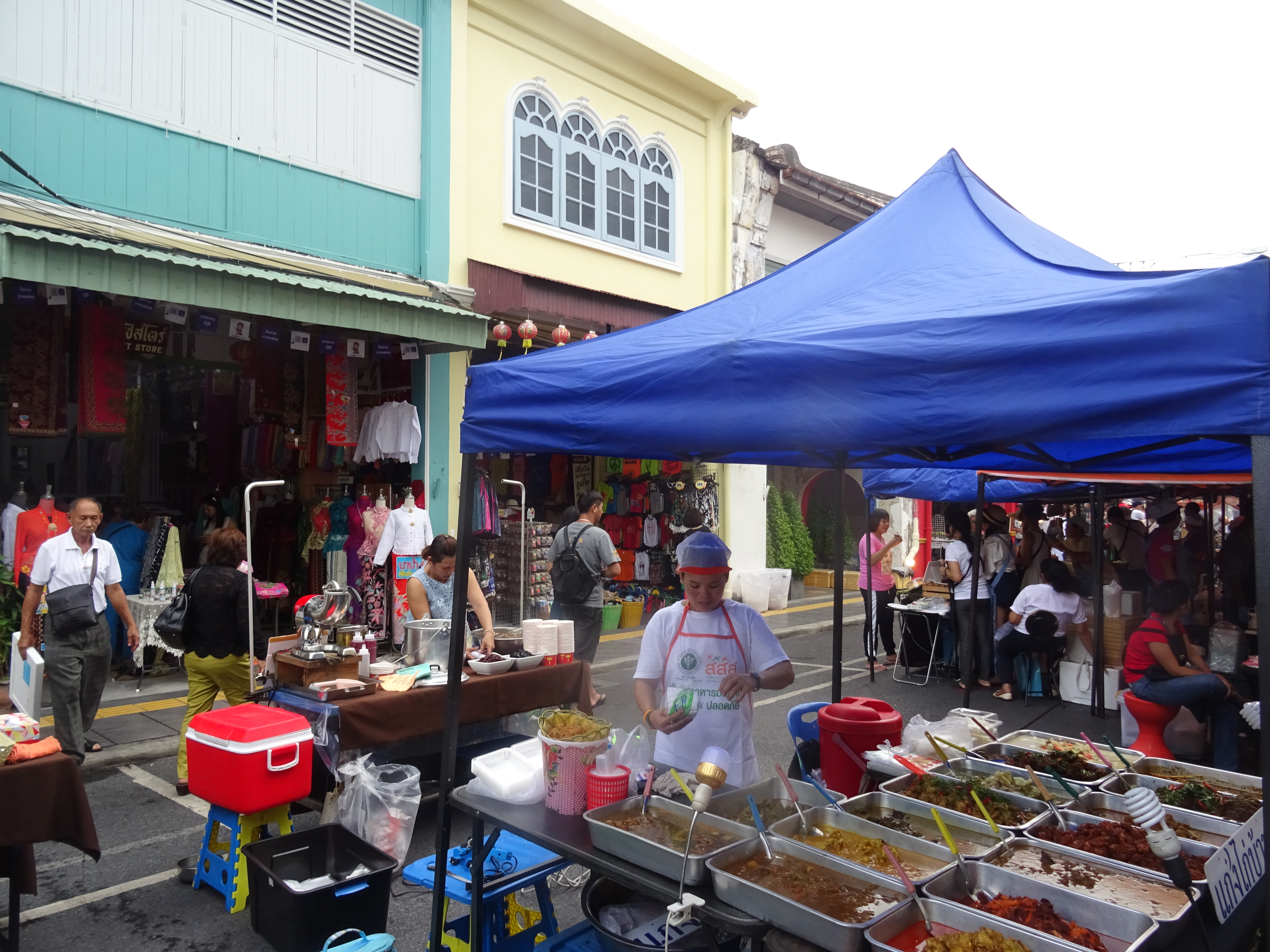
If you can choose your day, choose Sunday, and build the whole visit backwards from the market. Every Sunday, Thalang Road closes to traffic in the afternoon and becomes Lard Yai — "big market" in the southern dialect — Phuket's Sunday Walking Street, running since late 2013 along the roughly 360-metre length of Thalang and spilling into Phang Nga Road.
| Detail | Fact (TAT / Phuket City Municipality listings, checked Nov 2026) |
|---|---|
| Day | Sunday only, every week of the year |
| Hours | 16:00–22:00 officially; some listings say stalls run later, and Phuket 101 gives 16:00–21:00, often later — plan on the 16:00–22:00 window |
| Entry | Free |
| Food prices | Most dishes ฿20–80: skewers ฿10–20 a stick in earlier checks, moo hong and Hokkien mee ฿50–80, roti ฿40–60, o-aew ฿30–50 |
| Realistic budget | ฿300–500 a person to eat very well, grazing stall to stall |
| Best arrival | 16:30–17:00: facades in daylight, stalls set up, crowd still thin. By 19:00 you move at the crowd's speed |
| Parking warning | Thalang Road and Soi Romanee close from early afternoon. A car left on either is stuck until the stalls pack up |
| Rain | Stalls trade through light rain; the market is thinner on wet monsoon evenings |
Which day? The table nobody else publishes
| Day | What is open | What is closed or different | Verdict |
|---|---|---|---|
| Sunday | Everything, plus Lard Yai 16:00–22:00; Museum Phuket 13:00–20:30 | Streets busy from mid-afternoon; parking scarce | The day to pick |
| Tuesday–Saturday | Full quarter: both paid museums, Museum Phuket 09:00–16:30, all breakfast shops | No market; Thalang is a normal traffic street | The connoisseur's days: quiet mornings, everything open |
| Monday | Streets, shrines, dim sum, some cafés | Museum Phuket closed; Go Benz closed; several shops and restaurants take Monday off; Thai Hua's closing day is disputed and may be Monday | Avoid if it is your only day; fine for a breakfast and a walk |
| Wednesday | Almost everything | Some listings give Wednesday as Thai Hua Museum's closing day — phone 076 211 224 if it is your target | Good, with that one check |
Two ready-made routes
The morning route (3–4 hours, any day except Monday)
- 07:00 — Dim sum breakfast (Boonrat or an old-town breakfast shop), ฿60–150 a head.
- 08:00 — Roti Taew Nam if you have room, then walk Thalang Road end to end while it is still quiet; cut through Soi Romanee to Dibuk Road.
- 09:00 — Thai Hua Museum as it opens (฿200), an hour inside.
- 10:15 — Chinpracha House on the same street (฿150), 30–45 minutes.
- 11:00 — Shrine of the Serene Light off Phang Nga Road, then Museum Phuket (free) and the clock tower.
- 12:00 — Lunch at Lock Tien (฿50–80 a plate), o-aew for dessert. Done by 13:00, before the worst heat.
The Sunday route (afternoon into night)
- 15:30 — Arrive and park outside the closure zone (below). Coffee in a shophouse café (typically ฿70–120).
- 16:00 — Walk the streets in late light: Soi Romanee and Dibuk are at their best now; Museum Phuket is open until 20:30 if you want it.
- 16:30–17:00 — Enter Thalang Road as Lard Yai opens; photograph the facades before dark.
- 17:00–20:00 — Graze the market (budget ฿300–500), watch the stage, shop the craft stalls.
- 20:00 onwards — A sit-down drink or dessert on Phang Nga Road, or the songthaew/Grab ride back — note the last songthaews leave around 17:00–18:00, so after the market it is Grab, Bolt or taxi (prices below).
Getting there: every way from the beach towns, priced
| From | Blue songthaew (daytime) | Smart Bus | Grab / Bolt car (typical range) | Taxi / tuk-tuk (typical range) | Time by road |
|---|---|---|---|---|---|
| Patong | ฿30–50, about every 20–30 min, roughly 06:00–18:00, last runs about 17:00 | Route 2, Phuket Town–Patong, ฿50 flat | ฿300–450 | ฿500–700 | 30–45 min |
| Kata / Karon | ฿40–50, daytime only | Change in town or at Central; ask the driver | ฿350–450 | ฿500–700 | 35–50 min |
| Kamala / Surin | No direct songthaew for most visitors; go via town routes or change | — | Typically ฿400–600 | Typically ฿600–800 | 35–50 min |
| Phuket Airport | — | Airport bus to Phuket Town about ฿100 | ฿450–600 | Counter taxi about ฿550–700 | 45–60 min |
| Within Phuket Town | Pink town songthaew about ฿15 a ride | Free Dragon Line shuttle loops the Old Town on its published route — check current stops locally | Short hops typically ฿100–200 | Agree the fare before you board | — |
The songthaew system is the local secret and the local trap in one: unbeatable value in daylight (the blue trucks leave from the Ranong Road terminal by the fresh market, pay cash on board), and finished by early evening. That single fact shapes a Sunday trip: ride in cheaply by songthaew if you arrive for the afternoon, but budget for a Grab or Bolt car home after Lard Yai. Driving yourself, park on Dibuk Road side streets or near the Ranong Road market, use the Thai Hua Museum's free car park if you are visiting it, and on Sundays arrive before 16:00 and park outside the Thalang closure — never on Thalang or Soi Romanee themselves.
Staying longer and basing yourself on the west coast? Our where to stay in Phuket guide, with hotels by area and real baht prices puts Old Town's beds in island context, and drivers based in Patong for a month or more should compare the Old Town day-trip cost against simply living nearer the action in the long-term condo rental guide for Patong Beach.
Sleeping in the Old Town: what a night costs
| Band | Typical range a night (high season) | What it buys |
|---|---|---|
| Budget / hostel and fan rooms | ฿400–1,000 | Simple rooms and well-run hostels a few streets from Thalang |
| Shophouse boutique (the Old Town sweet spot) | ฿900–3,000 | Restored Sino-Portuguese boutiques around Thalang, Dibuk and Soi Romanee, character included |
| Named anchor: The Memory at On On Hotel | From about ฿800 in our Nov 2026 check; other 2026 listings show about US$20–45 | Phuket's oldest hotel (built 1927 as the Un Un Hotel), 19 Phang Nga Road, famous as the backpacker hotel in the film The Beach; renovated, no pool — you are paying for history and location |
| Top of the Town range | Up to about ฿3,500 | The best boutique suites in the quarter; there is no true luxury tier in the Old Town itself |
Sleep here if: you have an early flight (the airport is 45–60 minutes, with none of the west-coast traffic risk), you are in town for the Sunday market and do not want the late ride back, or you simply prefer kopi and dim sum to a beach buffet. Day-trip if your trip is short and beach-based — and if you are choosing a beach base first, start with the best beaches in Phuket, with prices and swim safety for every beach.

Worked budgets: three Old Town days, fully priced
| Day | Items | Total a person |
|---|---|---|
| The ฿250 morning (no paid museums) | Songthaew from Patong ฿40 + dim sum ฿100 + kopi ฿40 + Lock Tien plate ฿70; Museum Phuket and shrines free | About ฿250, plus ฿40–50 for the songthaew back if before 17:00 |
| The full culture day (about ฿800) | Dim sum ฿150 + Thai Hua ฿200 + Chinpracha ฿150 + café coffee ฿120 + ice cream ฿120 + lunch ฿70 at Lock Tien class prices | About ฿800 a head, transport on top |
| The Sunday (about ฿900–1,300 from Patong) | Songthaew in ฿40 + café ฿100 + Lard Yai grazing ฿400 + a craft souvenir ฿100–300 + Grab home ฿300–450 | About ฿900–1,300 a head, all in |
Set those numbers against a single beach-club afternoon or one island tour per person, and the point of this guide makes itself: the Old Town is not a consolation prize for a rainy day. Priced properly, it is the best-value day out in Phuket. For tour prices to compare it against, see Phuket tours with real prices: every day trip compared, local operator vs OTA.
Frequently asked questions
How long do you need in Phuket Old Town?
Three to four hours covers the street loop, one museum and lunch. One hour gets you Thalang Road and Soi Romanee photographs. A Sunday deserves the whole afternoon and evening, from about 15:30 to the market's close at 22:00.
What is the best day to visit Phuket Old Town?
Sunday, for Lard Yai (16:00–22:00, free entry). Tuesday to Saturday are the quiet, everything-open days. Avoid Monday if you can: Museum Phuket is closed, several restaurants and shops close, and the Thai Hua Museum's closing day is disputed between Monday and Wednesday in current listings.
How much does the Thai Hua Museum cost?
฿200 for a foreign adult and ฿120 for a child; ฿50 and ฿25 for Thai nationals. Taking photos inside costs an extra ฿200 photo pass. It opens 09:00–17:00 at 28 Krabi Road; phone 076 211 224 to confirm the closing day before a Monday or Wednesday trip.
Is Museum Phuket really free?
Yes. Entry to both buildings at the Phang Nga/Phuket Road corner — the former Chartered Bank and the clock tower police station — is free. Hours are Tuesday–Saturday 09:00–16:30 and Sunday 13:00–20:30; closed Mondays.
How do I get from Patong to Phuket Old Town cheaply?
The blue songthaew from Patong costs ฿30–50 and takes 45–60 minutes in traffic, running roughly 06:00–18:00 with the last runs about 17:00. The Smart Bus town–Patong route is ฿50 flat. After about 18:00, use Grab or Bolt (typically ฿300–450 from Patong) — there is no cheap late bus back.
What should I eat in Phuket Old Town?
Dim sum for breakfast (฿15–30 a basket), charcoal roti with beef curry at Roti Taew Nam (roti from ฿20), Hokkien mee, o-tao and loba at Lock Tien (฿50–80 a plate), moo hong for lunch or dinner, and o-aew shaved ice (฿30–50) whenever the heat wins.
When is the Lard Yai Sunday market?
Every Sunday, 16:00–22:00 on official TAT and municipal listings, on Thalang Road. Arrive 16:30–17:00 for daylight facades and a thin crowd; by 19:00 it is packed. Food is mostly ฿20–80 a dish, and ฿300–500 a person eats very well.
Can I visit Phuket Old Town with children?
Yes — it is flat, compact and full of ice cream. The workable family pattern is the morning route (dim sum, streets before the heat, one museum, Lock Tien lunch) or an early Sunday market arrival at 16:30 before the crowd peaks.
Is Phuket Old Town worth it if I only have three days in Phuket?
Yes, as a half day — ideally the Sunday half. It is the only place on the island that shows you Phuket rather than a resort version of Thailand, it costs about ฿250–800 a person all-in depending on museums, and it is the island's best rainy-day plan.
Where do I park in Phuket Old Town?
On Dibuk Road side streets, near the Ranong Road market, or in the Thai Hua Museum's free car park when visiting it. On Sundays, park outside the Thalang Road closure and arrive before 16:00 — cars left on Thalang or Soi Romanee are trapped until the market packs up.
Sources and how prices were checked
Checked 19 November 2026. Lard Yai day/hours/free entry: TAT Phuket e-brochure and Phuket City Municipality listings (Sunday 16:00–22:00), cross-checked against Phuket 101's Old Town guide (16:00–21:00, often later). Thai Hua (฿200/120 foreign, ฿50/25 Thai, +฿200 photo pass, 09:00–17:00, 28 Krabi Road, phone 076 211 224) and Chinpracha (฿150 foreign / ฿100 Thai, 09:00–16:30, 98 Krabi Road): Phuket 101 museum pages and listings checked October–November 2026; Thai Hua closing-day listings disagree (Monday vs Wednesday), stated openly in the text. Museum Phuket free entry and Sunday hours: Phuket 101, TAT (February 2025) and listings checked November 2026. Food prices: October 2026 Old Town food guides (Boonrat, Lock Tien, Torry's), Phuket 101's Roti Taew Nam menu page and its Michelin Guide listing. Transport: 2026 Phuket transport guides compiling songthaew, Smart Bus, Grab/Bolt and taxi fares, cross-checked against this site's price bible set. Hotels: this site's November 2026 island check (628 properties) and 2026 budget listings for the On On. Street art: F.A.T. / So Phuket project record and Phuket street-art guides.
Photo credits: photographs in this post are from Wikimedia Commons, used under the licences stated on their file pages — Thalang Road and Soi Romanee (Slleong, CC0; Christophe95, CC BY-SA 4.0), Museum Phuket clock tower (JULIANISME, CC BY-SA 4.0), Phang Nga Road mural (CEphoto, Uwe Aranas, CC BY-SA 4.0), Thalang Road market (Christophe95, CC BY-SA 4.0) and Khao Rang view (Oleg Bor, CC BY-SA 4.0). Scott's own library holds no Phuket Old Town streetscape yet — an Old Town shoot is on the photo-needs list, and his photos will replace these when it happens.
Comments